
Journal · The Thinking Clinician · Part 1 of 8
When Better Answers Do Not Mean Better Doctors
By Dr. Bassam Nuseibeh ·
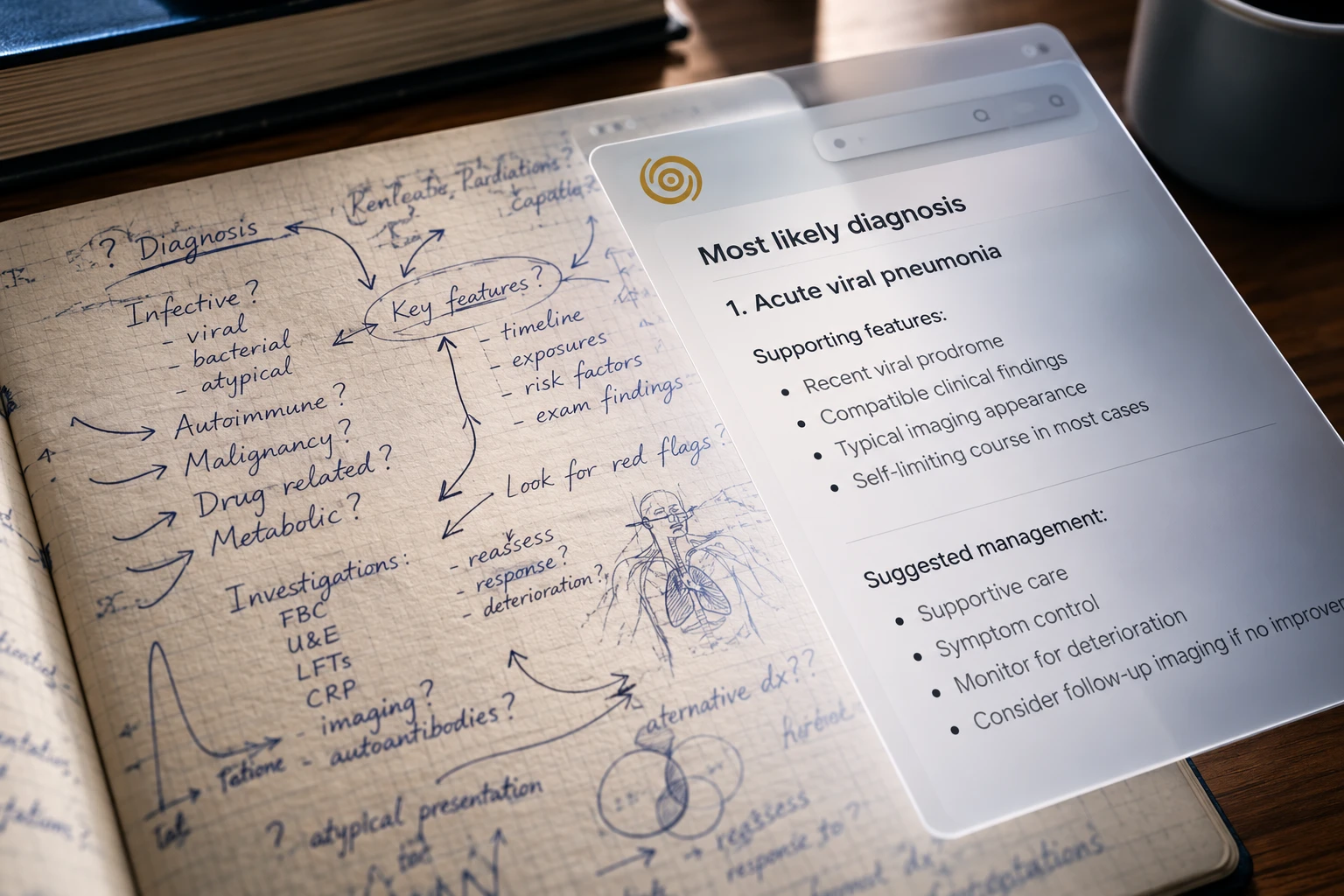
Artificial intelligence is transforming access to medical knowledge. Whether it strengthens clinical judgement is another matter.
Medicine has spent generations teaching doctors how to arrive at an answer. We are now introducing technology that can provide one before the reasoning has begun. A differential diagnosis can be generated in seconds. Complex physiology can be explained with remarkable clarity. Clinical uncertainty can be met with an answer that is immediate, coherent and often convincing.
It is an extraordinary achievement. But access to knowledge is not the same as understanding it.
As a clinician, I increasingly use AI to explore unfamiliar concepts, interrogate evidence and challenge my own assumptions. Its ability to synthesise information is remarkable, and its potential to improve both clinical practice and medical education is difficult to dismiss. Yet I find myself considering a distinction that is becoming increasingly important: whether the technology is extending our thinking or quietly replacing parts of it.
Medicine has never demanded that we know everything. We consult textbooks, follow guidelines, use calculators and seek advice from colleagues. Recognising the limits of our knowledge is itself a clinical skill. AI is different not because it provides assistance, but because it can perform much of the reasoning that assistance once supported.
Consider two clinicians assessing an unfamiliar presentation. One asks AI to construct a differential diagnosis. The other develops an assessment independently, then asks AI to challenge it, identify omissions and explore competing explanations. Both may reach the same conclusion. Both may deliver excellent care. But the intellectual demands are different. In one, AI initiates the reasoning. In the other, it interrogates reasoning already undertaken.
That distinction may matter more than we realise.
In a 2024 randomised study published in JAMA Network Open, physicians given access to a large language model did not significantly outperform colleagues using conventional resources in diagnostic reasoning exercises, despite the model performing well independently. The study was small and its findings cannot be generalised to every clinical setting. Nevertheless, it illustrates an uncomfortable possibility: increasingly capable technology does not automatically produce increasingly capable clinicians.
The concern becomes more consequential when we consider medical education.
For experienced clinicians, AI often arrives after years spent accumulating knowledge, recognising patterns, making mistakes and learning to navigate uncertainty. For medical students, it may be present before those foundations have developed. The opportunities are considerable. Individualised teaching, immediate feedback and access to explanations once dependent on the availability of an experienced educator could transform how medicine is learned.
But there is a difference between recognising a correct explanation and being able to produce one. The ease with which AI supplies reasoning may conceal the intellectual effort required to develop it. Researchers have begun describing the possibility of never-skilling: foundational abilities that may never fully develop because technology performs the relevant work first. It remains a hypothesis rather than an established consequence, but the distinction deserves attention.
None of this requires us to preserve the inefficiencies of traditional medical education. Spending hours searching for information does not necessarily produce deeper understanding. Much of that effort can, and perhaps should, be eliminated. The difficulty lies in distinguishing unnecessary work from the cognitive processes through which clinical expertise develops.
This is where AI literacy becomes important. It is not simply the ability to construct an effective prompt. It is the capacity to recognise the limitations of a system, interrogate its assumptions, evaluate conflicting information and identify when an apparently convincing recommendation is wrong. Human oversight offers little protection when the person providing it lacks the understanding necessary to exercise judgement.
We should embrace technology that makes medicine more accessible, more efficient and potentially safer. But we should be equally deliberate about what we delegate, what we continue to learn and how we assess the competence of those increasingly working alongside it.
A correct answer has never been the entirety of good medicine. Clinical judgement lies in understanding why it is correct, recognising when it is not, and accepting responsibility for what follows.
Artificial intelligence may change how we arrive at our decisions. It should not relieve us of the responsibility to understand them.
General information for clinicians. It is not medical advice and does not replace professional judgement.