
Journal · The Thinking Clinician · Part 2 of 8
Never-Skilling: When the Answer Comes Before the Learning
By Dr. Bassam Nuseibeh ·
Artificial intelligence may transform medical education. But access to expertise is not the same as acquiring it.
A medical student can now produce an answer that might once have required years of specialist training to formulate. The explanation may be accurate, comprehensive and entirely convincing.
But the student has not necessarily learned anything.
This is the paradox emerging in medical education. We have made answers easier to obtain without establishing whether we are making the reasoning easier to acquire.
For generations, clinical expertise has developed through repeated exposure to uncertainty. Students learn to retrieve knowledge, construct explanations, recognise errors and gradually connect unfamiliar presentations with underlying physiological principles. It is an imperfect process, often inefficient, but one through which clinical judgement develops.
Artificial intelligence is beginning to alter that relationship.
In a 2026 perspective published in Nature Medicine, researchers introduced the concept of AI-induced never-skilling. Unlike deskilling, where previously acquired abilities deteriorate through disuse, never-skilling describes the possibility that foundational skills may never develop because technology performs the intellectual work through which they would ordinarily be acquired.
The distinction is consequential.
A student who uses AI to produce an expert answer has demonstrated access to expertise. They have not necessarily demonstrated possession of it.
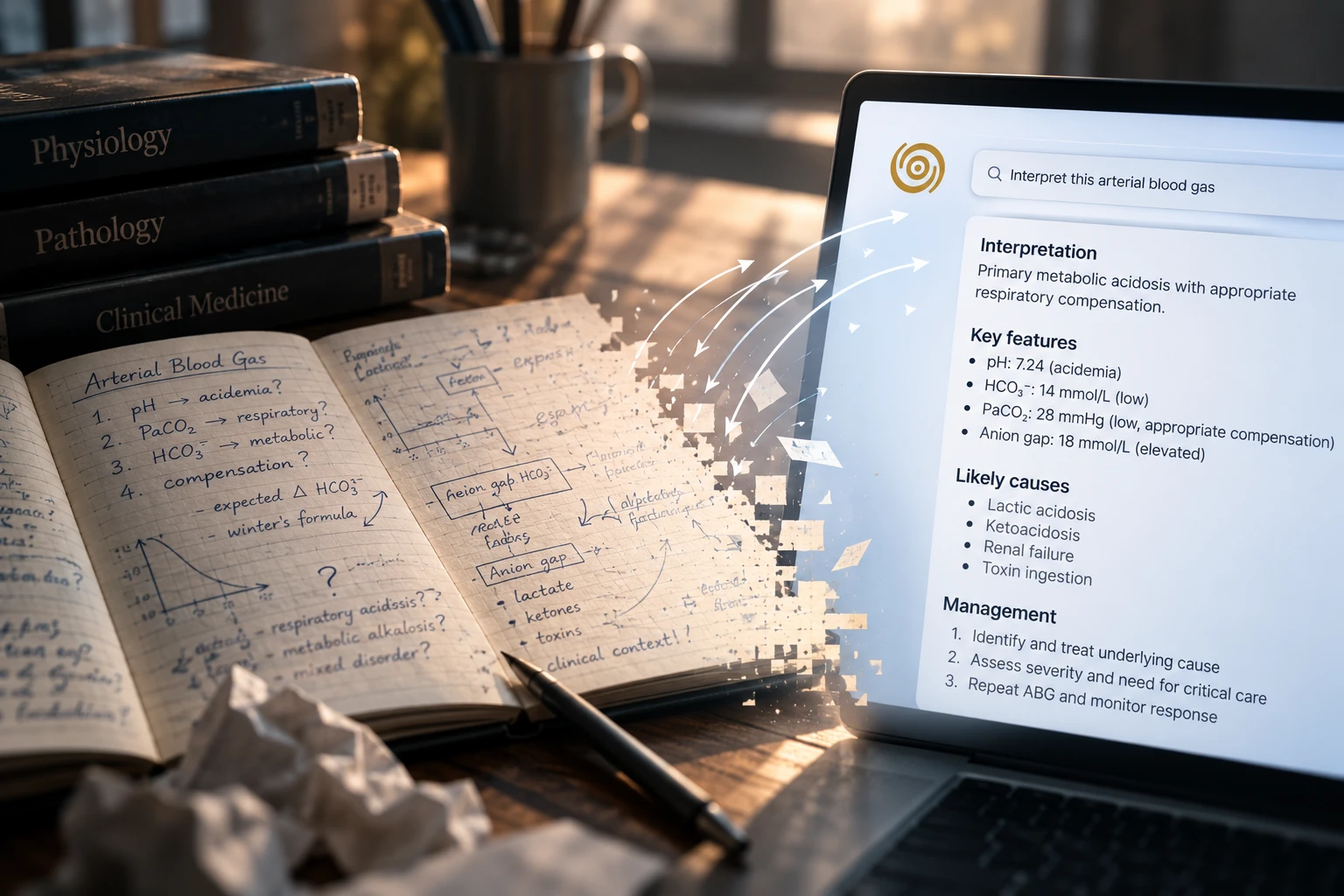
Consider something as familiar as interpreting an arterial blood gas. AI can identify the acid–base disturbance, calculate the expected compensation and explain the physiology within seconds. A student may read the explanation and understand every word.
But change the numbers, introduce an unexpected finding or remove the assistance, and a different question emerges. Can the student reconstruct the reasoning independently?
Recognising an explanation is not the same as producing one.
This is not evidence that AI is causing a generation of poorly trained doctors. Direct research demonstrating never-skilling in medical education remains absent. The concept is a hypothesis, not an established outcome.
Nor should we romanticise the difficulties of traditional medical training.
Students have long endured inconsistent teaching, limited access to experienced educators and countless hours searching for explanations that should have been readily available. Difficulty does not automatically produce understanding. Sometimes it simply wastes time.
AI offers an opportunity to correct those failures. Individualised explanations, simulated clinical encounters and immediate feedback could make high-quality education available to students who might otherwise struggle to access it.
A 2026 systematic review of 20 randomised trials involving more than 1,400 medical learners found improvements in measured knowledge and clinical skills with AI-assisted teaching. Evidence of longer-term independent competence remains limited, but the findings challenge the assumption that AI necessarily undermines learning.
The problem, then, is not whether learning becomes easier. It is whether we distinguish unnecessary educational friction from the cognitive effort through which expertise develops.
An AI tutor that immediately provides an answer offers something different from one that asks a student to reason through a problem, challenges an incomplete explanation and provides feedback after an independent attempt.
Both may be useful. But they do not necessarily cultivate the same abilities.
This places a responsibility on medical educators, universities and those developing educational technologies. Success cannot be measured solely by how accurately students answer questions with AI assistance. We must also understand what they retain, how they reason when the technology is unavailable and whether their knowledge transfers to unfamiliar clinical situations.
A generation of doctors fluent in artificial intelligence would be an achievement. A generation unable to recognise when it is wrong would represent a failure of education.
We should welcome technology that makes knowledge more accessible. But accessibility must not be mistaken for mastery.
The responsibility is not to preserve the struggle of learning for its own sake. It is to preserve the learning that some of that struggle makes possible.
General information for clinicians. It is not medical advice and does not replace professional judgement.